Lean Enterprise Institute Logo
  • Contact Us
  • Newsletter Signup
  • Cart (0)
  • Account
  • Search
Lean Enterprise Institute Logo
  • Explore Lean
        • What is Lean?
        • The Lean Transformation Framework
        • A Brief History of Lean
        • Lexicon Terms
        • Topics to explore
          • Operations
          • Lean Product and Process Development
          • Administration & Support
          • Problem-Solving
          • Coaching
          • Executive Leadership
          • Line Management
  • The Lean Post
        • Subscribe to see exclusive content
          • Subscribe
        • Featured posts
          DesignBrief Mentors helping others up the. mountain

          Excellence Isn’t an Accident: Mentorship as the...

          How I’ve Aimed to Share the Uncommon Knowledge of Lean Product and Process Development

          A Toyota Take on Taking TPS to...

          • See all Posts
  • Events & Courses
        • 2026 Lean Summit
          March 12-13
        • Forms and Templates
        • Featured learning
          • Managing on Purpose with Hoshin Kanri

            September 12, 2025 | Coach-Led Online Course

          • Webinar: Lean AI

            September 17, 2025 | Webinar

          • Lean Warehousing and Distribution Operations

            September 17, 2025 | Plymouth, WI & Gainesville, FL

          • Designing the Future Using Lean Product and Process Development

            September 22, 2025 | Coach-Led Online Course

          • See all Events
  • Training & Consulting for Organizations​
        • Interested in exploring a partnership with us?
          • Schedule a Call
        • Getting Started with Lean Thinking and Practice
        • Leadership Development
        • Custom Training
        • Lean Enterprise Transformation​
        • Case Studies
  • Store
        • Book Ordering Information
        • Shopping Cart
        • Featured books
          How I’ve Aimed to Share the Uncommon Knowledge of Lean Product and Process Development

          Daily Management to Execute Strategy: Solving problems and developing people every day

          Managing on Purpose Workbook

          Managing on Purpose

          • See all Books
  • About Us
        • Our people
          • Senior Advisors and Staff
          • Faculty
          • Board of Directors
        • Contact Us
        • Lean Global Network
        • Press Releases
        • In the News
        • Careers
        • About us

The Lean Post / Articles / How I’ve Aimed to Share the Uncommon Knowledge of Lean Product and Process Development

The Design Brief: How I’ve Aimed to Share the Uncommon Knowledge of Lean Product and Process Development

Product & Process Development

How I’ve Aimed to Share the Uncommon Knowledge of Lean Product and Process Development

By Larry Navarre

August 28, 2025

In this edition of The Design Brief: From factory floors to the classroom, LPPD’s core lesson stands—learn by doing, then design. A project-based course turns that into skill and challenges practitioners to contribute examples, research, and mentorship.

FacebookTweetLinkedInPrintComment

My exit ramp from a rewarding 20-year corporate career in the steel, machinery, and plastics industries led me to Kettering University, a private university in Flint, MI, specializing in STEM 17 years ago. As a “pracademic,” I teach my students the leadership of innovation development using practical methods that work in industry, like lean product and process development (LPPD).

Lean, in general, and LPPD specifically, is a set of “uncommon knowledge”; in other words, the principles that work but are not obvious. This is the real value of a discipline. Yet, encouraging learners to change their way of thinking to accept something different, no matter how good it appears, is not easy.

A few years into my second career of teaching, Kettering asked its professors to add some entrepreneurial activity to their courses. I went one step further and asked to create an entirely new course in new product development, and they let me! I had many years of experience in leading development in a mid-size industrial company and was delighted to teach principles of new product development. 

Given the wise recommendation of another academic, I chose a well-regarded text on the subject. Still, it didn’t have LPPD in it. Over the years, I migrated this course away from typical development to teaching mostly LPPD, with more traditional development to round out the innovation system. Why? LPPD is about learning first through experimentation and then designing great products. Test, then design. I still teach this course, known as “Innovation Development,” at Kettering today.

Learning by doing

Project-based learning is the most appreciated feature of courses I teach. I learned good methods of teaching from great corporate trainers. Fortunately, this approach is increasingly common in higher education, yet the emphasis on lecture and recitation is persistent. I can work passionately to present carefully crafted course content, but nothing compares to applying it to a project of your own imagination.

Students pick a course project, then apply LPPD principles to their project. The best classes are those when I (briefly!) introduce principles of the topic, then students apply them. Often, there are one or two short exercises that reinforce the principles before they apply them. I provide guidance, suggestions, and feedback, which is sometimes called “grading.” In short, what seems to work is just doing the work of LPPD. Practicing the principles by doing the method is what sticks, and yes, students need a coach.

I can tirelessly explain a lean principle and provide examples, but when the exercise that applies to that principle begins, no one does it the lean way the first time. It takes coaching and practice doing the LPPD way for it to stick. What we do in LPPD is hard because it is not the norm, and it’s effective precisely for this reason. Like most educators, seeing the “light bulbs go on” when students start to understand something new and challenging is a great reward. There are so many lessons here for how we develop talent in our organizations.

What comes next

A company that truly practices LPPD is rare. A fraction of organizations actually do development, and development is not a large function in an organization. Plus, the number of people who lead the innovation system are few.

Change is in the air. And while a true LPPD organization is rare, many organizations are beginning to practice the principles of LPPD without identifying them as such.

However, we’ve now witnessed three decades of expansion of LPPD from a few researchers to an established discipline. Change is in the air. And while a true LPPD organization is rare, many organizations are beginning to practice the principles of LPPD without identifying them as such. Some amazing organizations are doing development dramatically differently, and they look a lot like LPPD. The names change, but the uncommon principles are solid. Principles like Put People First; Understand Before You Execute; Make Product Development a Team Sport; Synchronize Workflows; Build in Learning and Reuse Knowledge; and Design the Value Stream

So, as LPPD leaders and practitioners, we need to help each other out. We need more sharing of examples, ideas, materials, and exercises. We need more researchers investigating why LPPD works and generalizing that knowledge, and we need to deliver more learning opportunities to coach and mentor the next generation of practitioners.The youngest generations of practitioners are entering the workforce with great capabilities and a desire to do good and do well. We’ve seen what is good. Even if getting people to think differently about product development is challenging, we owe these generations the time and attention of our mentoring skills.

FacebookTweetLinkedInPrintComment

Designing the Future Using Lean Product and Process Development

Learn how to reduce time to market, improve quality, and drive innovation in a hands-on, coach-led experience that applies Lean Product and Process Development across your value stream.

Written by:

Larry Navarre

About Larry Navarre

Larry Navarre is a full-time Lecturer at Kettering University teaching courses in innovation development, supply chain management, project management, and business analytics since 2008.

Larry has earned a Bachelor of Business Administration degree from Kent State University (Kent, Ohio) and a Master of Science in Management degree from Purdue University’s Krannert Graduate School of Management (West Lafayette, Indiana). Larry has 20 years of management experience in the steel, machinery, and plastics industries. His management responsibilities have spanned from Production Supervisor to Director of Global Product Management and Asian Operations.

He has worked internationally with customers, suppliers, and colleagues in 20 countries. Larry serves on the board of the Lean Product and Process Development Exchange, a nonprofit for educating methods of innovation. He is also a managing owner of a family-owned small business managing commercial real estate for over 20 years.

Leave a Comment Cancel reply

Your email address will not be published. Required fields are marked *

Related

Innovation as a Core Capability: Sebastian Fixson on Why Leaders Need Lean Product and Process Development 

Product & Process Development

Innovation as a Core Capability: Sebastian Fixson on Why Leaders Need Lean Product and Process Development 

Article by Sebastian Fixson and James Morgan, PhD

Data is Good; Facts that Tell You What’s Actually Happening in Your Business Are Better 

Product & Process Development

Data is Good; Facts that Tell You What’s Actually Happening in Your Business Are Better 

Article by Eric Ethington

7 Lessons for the Next Generation of Lean Product and Process Development Leaders

Product & Process Development

7 Lessons for the Next Generation of Lean Product and Process Development Leaders

Article by Lex Schroeder

Related books

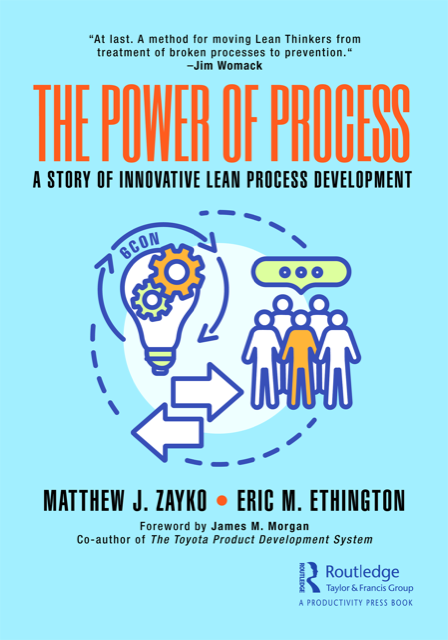
The Power of Process book cover

The Power of Process – A Story of Innovative Lean Process Development

by Eric Ethington and Matt Zayko

Welcome Problems, Find Success – Creating Toyota Cultures Around the World

Welcome Problems, Find Success – Creating Toyota Cultures Around the World

by Nate Furuta

Related events

September 22, 2025 | Coach-Led Online Course

Designing the Future Using Lean Product and Process Development

Learn more

October 07, 2025 | Rochester, MI

Introduction to Lean Process Development

Learn more

Explore topics

Product and Process Development graphic icon Product & Process Development

Sign up to be notified about new events

Subscribe
  • Privacy Policy
  • Sitemap
  • LinkedIn
  • Twitter
  • YouTube
  • Instagram
  • Facebook

©Copyright 2000-2025 Lean Enterprise Institute, Inc. All rights reserved.
Lean Enterprise Institute, the leaper image, and stick figure are registered trademarks of Lean Enterprise Institute, Inc.

This website uses cookies to improve your experience. We'll assume you're ok with this, but you can opt-out if you wish. Learn More. ACCEPT
Privacy & Cookies Policy

Privacy Overview

This website uses cookies to improve your experience while you navigate through the website. Out of these cookies, the cookies that are categorized as necessary are stored on your browser as they are essential for the working of basic functionalities of the website. We also use third-party cookies that help us analyze and understand how you use this website. These cookies will be stored in your browser only with your consent. You also have the option to opt-out of these cookies. But opting out of some of these cookies may have an effect on your browsing experience.
Necessary
Always Enabled
Necessary cookies are absolutely essential for the website to function properly. This category only includes cookies that ensures basic functionalities and security features of the website. These cookies do not store any personal information.
Non-necessary
Any cookies that may not be particularly necessary for the website to function and is used specifically to collect user personal data via analytics, ads, other embedded contents are termed as non-necessary cookies. It is mandatory to procure user consent prior to running these cookies on your website.
SAVE & ACCEPT