

Here at The Design Brief we’re always asking ourselves, how are we meeting the needs of our customers: business leaders who want to use lean product and process development (LPPD) to build stronger teams and high-performing organizations? This means thinking about the different ways people learn and sharing LPPD lessons in multiple formats. Read on for seven key lessons we’ve gathered for the next generation of LPPD leaders. All are from past Design Brief podcasts and articles linked below. And please tell us, what would you like to learn more about?
1) Former Ford CEO Alan Mullaly on putting people first to build a strong team
“We’re all human beings, and we really do want to contribute, we want to make a difference, so the most important thing as a leader is to pull everybody together around the vision for the business or the product, pull everybody together around the strategy for achieving it—not only the technical strategy but the partnership strategy and the expected behavior strategy. Then, make that really clear, really intentional, and then just start operating with this process and these behaviors.
Any time you see a behavior that’s not consistent with what you’ve agreed to work on together (like respect each other and help each other), stop the meeting or talk to the person in private … 80-plus percent of the time when you’re clear about the process, and you’re clear about the behaviors from a product point-of-view or a business point-of-view, 80-plus percent of the time people will move very positively to a working-together contributor [role].” Listen to the podcast.
2) Product leader and angel investor Phil Green on “minimum valuable process” over “minimum viable product”
“I love the work [The Lean Startup author] Eric Ries did, and I teach MVP all the time, but I don’t like ‘minimal viable product’. Because I don’t think that’s what’s really meant by this whole thing. Minimal … there’s no disagreement there. The key thing is, minimal means do as little work as possible for the maximum number of learnings. Viable I have issues with … I think valuable makes it more pointed. It’s got to be valuable to the customer; if it doesn’t touch on the value the customer is really trying to achieve, then you’re not testing what you’re trying to sell to them eventually … Then product—in fact, Eric himself said it’s about process … You’re going to iterate a lot.” Listen to the podcast.
3) MIT’s Steve Spear on creating the conditions for better problem-solving
“When it comes to innovation in products, processes, services … to accomplish anything, particularly things that are audacious, what we have to do is harness the intellectual horsepower of people distributed throughout the organization into collaboration and coordination which is really meaningful and productive. When we start looking at organizations that have succeeded way outside the norms of their fields, any look we take will reveal, senior leadership and leadership at all levels and all roles—[people are] hyper-concerned about creating conditions in which it’s much easier for people to solve hard technical problems (for which there is great value to society) and spending far less time solving ‘system’ problems of who am I, where do I fit in, what do I do, what do I depend on, who is dependent on me, etc.” Listen to the podcast.
4)Professor, author, and lean coach Jeff Liker on running experiments to stay adaptive
“Most students of engineering learn that the game is about control. They are taught a lot about predictive problem-solving, with relatively little about adaptive problem-solving … Adaptive problem-solving is more circumspect. Even the problem definition is unclear and can take extensive investigation and benefits from direct observation of the actual processes as they are carried out …
At Toyota, the starting assumption is that most problems are messy. For example, we’ve studied Toyota’s approach to prototyping and found they are more likely than competitors to encourage a lot of rapid physical prototyping … even in the study stage before they have designed the full vehicle. The concept of learning by doing at the gemba (the place where the real, value-creating work gets done) is deeply ingrained in Toyota culture. This is powerful because it reflects a humble attitude of accepting uncertainty. Leaders think, ‘We do not know, but we will develop our best guess and then try something.’” Read more.
5) Lean coach and author Sandrine Olivencia on why manufacturing and tech leaders need to work together
“[Manufacturing and tech leaders] are going to have to live with each other no matter what; the digital and physical world are merging … But we need to understand we are constrained by different laws. In the manufacturing world, we build physical objects, so we’re constrained by the laws of physics. In the digital world, we don’t have the same laws … Cost is [totally different] … We move fast, we’re able to iterate endlessly…
Manufacturing folks are going to need to speed up a bit and frankly, tech people are going to need to slow down a bit to pause and take a higher view on things, not just be stuck in the daily details. If we slow down and try to adjust our speed, we might be able to collaborate better. And no matter what, we don’t have a choice! That’s where lean engineering is awesome because it provides all the tools to do that, or a lot of them.” Listen to the podcast.
6) The Smithsonian Design Museum’s Cynthia Smith on using LPPD to build regenerative systems and structures
“In response to increasing urgent challenges–a warming planet, biodiversity loss, sea level rise, income inequality and more–this is going to require systemic and structural changes. And this is an opportunity–we really need to move from a mindset of simple sustainability to envisioning and implementing more regenerative, transformative designs and systems that can restore and revitalize our ecosystem. Those can take on many, many forms … A lot of designers see this as an opportunity for us to amend our relations not just with each other, but with other species.” Listen to the podcast.
7) Jim Morgan, former auto and startup executive and co-author of Designing the Future, on cross-functional work design and engaging everyone around creating value
“A first principle of lean is creating value, eliminating waste, but what’s oftentimes overlooked is it’s your product that represents that value. So whether your product is a process or a service, software or hardware, that’s the value you’re creating, that’s what represents value to your customer, and it’s critical to engage the entire organization and understand what that value represents, what it is. And oftentimes, if you don’t engage upstream in the development process, what we call kaizen is really rework. It’s fixing stuff that should have been much, much better coming out of the development process …
LPPD aims to create new value streams; it intentionally designs each step of the value-creating process, and we build that right into the development process. We build it in upfront during the study phase when cross-functional teams come together under the guidance of the chief engineer to deeply understand what value needs to be. We do it when creating the concept paper and outlining for everybody how the product creates value. And probably most importantly, the principle of compatibility before completion that we apply during the development process itself synchronizes activities … So whether it’s manufacturing, installation, serviceability —whatever portion of this product that helps improve the customer’s overall experience, we create integration points, we synchronize the way the work is done, so that they mature simultaneously. So you have the right input at the right time during the process, and so we have access into this process for everybody in the organization.” Read more.
Get Started with Lean Product & Process Development
Improving how you develop and deliver products doesn’t require a full transformation to start—it begins with learning to see problems clearly, involve your team, and improve how work gets done.
Explore your next step:
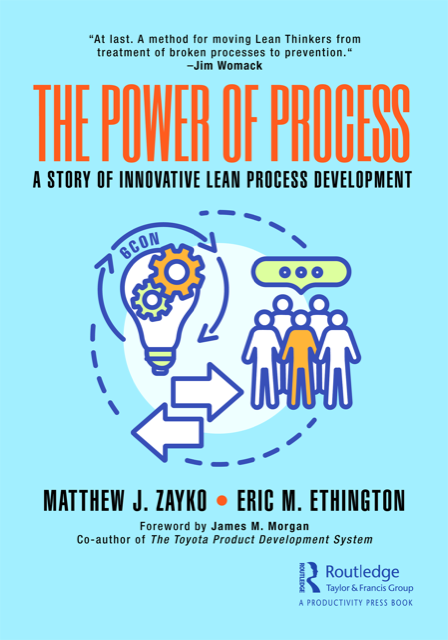
- Read Designing the Future or The Power of Process
- Take the 60-minute Lean Product and Process Development Overview course
- Join the coach-led online Designing the Future Workshop for hands-on practice, and the in-person Introduction to Lean Process Development course Oct 7
- Bring a coach into your organization for customized support
Let’s take the first step—together. Learn more at lean.org/LPPD »
Designing the Future Using Lean Product and Process Development
Learn how to reduce time to market, improve quality, and drive innovation in a hands-on, coach-led experience that applies Lean Product and Process Development across your value stream.






Hey Lex! Thanks for the insights and oppotunity to reflect.
Have you ever updated your brochure “Breakthrough Moments” basically the history of Lean, starting in 1500? It ended in 2008, and was told a newer version would be available many years ago…
I am very much a Lean Thinker and consultant who has helped many organizations over the years with Transitioning to a Lean environment, SpaceX-Agriculture Plants-Boeing-Many Automotive-Picture Framers etc etc…
Thanks for any insight, tried to call direct but no answer…
PS have visited your offices in Mass, many years ago, could use a dose of Competitive (Lean ) office I might add….
We have not at this time.