Lean Enterprise Institute Logo
  • Contact Us
  • Newsletter Signup
  • Cart (83)
  • Account
  • Search
Lean Enterprise Institute Logo
  • Explore Lean
        • What is Lean?
        • The Lean Transformation Framework
        • A Brief History of Lean
        • Lexicon Terms
        • Topics to explore
          • Operations
          • Lean Product and Process Development
          • Administration & Support
          • Problem-Solving
          • Coaching
          • Executive Leadership
          • Line Management
  • The Lean Post
        • Subscribe to see exclusive content
          • Subscribe
        • Featured posts
          DesignBrief Mentors helping others up the. mountain

          Excellence Isn’t an Accident: Mentorship as the...

          AI Might Change the Game—But People Still Build the Team

          A Toyota Take on Taking TPS to...

          • See all Posts
  • Events & Courses
        • 2026 Lean Summit
          March 12-13
        • Forms and Templates
        • Featured learning
          • Managing on Purpose with Hoshin Kanri

            September 12, 2025 | Coach-Led Online Course

          • Webinar: Lean AI

            September 17, 2025 | Webinar

          • Lean Warehousing and Distribution Operations

            September 17, 2025 | Plymouth, WI & Gainesville, FL

          • Designing the Future Using Lean Product and Process Development

            September 22, 2025 | Coach-Led Online Course

          • See all Events
  • Training & Consulting for Organizations​
        • Interested in exploring a partnership with us?
          • Schedule a Call
        • Getting Started with Lean Thinking and Practice
        • Leadership Development
        • Custom Training
        • Lean Enterprise Transformation​
        • Case Studies
  • Store
        • Book Ordering Information
        • Shopping Cart
        • Featured books
          AI Might Change the Game—But People Still Build the Team

          Daily Management to Execute Strategy: Solving problems and developing people every day

          Managing on Purpose Workbook

          Managing on Purpose

          • See all Books
  • About Us
        • Our people
          • Senior Advisors and Staff
          • Faculty
          • Board of Directors
        • Contact Us
        • Lean Global Network
        • Press Releases
        • In the News
        • Careers
        • About us

The Lean Post / Articles / AI Might Change the Game—But People Still Build the Team

Jeff liker and James Morgan learning at Toyota Japan

Product & Process Development

AI Might Change the Game—But People Still Build the Team

By James Morgan, PhD

July 24, 2025

Because it is people-centered, a lean product and process development (LPPD) approach to AI adoption can turn disruption into development excellence.

FacebookTweetLinkedInPrintComment

Several senior business leaders recently predicted that 40 to 50 percent of their employees will be replaced by AI. Staggering. First, I’m not sure that they really understand the current state of AI, and second, more importantly, they clearly don’t understand the full contribution of their people. 

The lean product and process development socio-technical model of product development is the perfect framework to bring the disparate AI technologies and people of various disciplines together.

That is sad. And what bothers me most is the way so many leaders are framing AI to their teams. Reality? Maybe, but that’s not the point. I’ll just say that this approach is the polar opposite of the “working together, people first” environment that I had the privilege of experiencing first-hand at Ford that then-CEO Alan Mulally led with every day. I saw the difference it made, and I can only hope that other leaders out there are being just as transparent while modeling Alan’s thoughtful, creative, and inspiring approach to people. 

AI in product development 

Technology has enabled product development in one form or another for a long time.  Smart CAD, parametric solid models, simulation programs, VR, virtual builds, white and blue light scanning, and many other tools have changed the engineering landscape since I first learned orthographic projection and manual section cutting on the drafting board.   

But I sense that AI will be bigger. Much bigger. I suspect it will dramatically impact nearly every aspect of how we develop new products. It will change the way we understand our customers, generate concepts, design, test, procure materials, launch, and manufacture even our most complex products. AI will be embedded both in our products and the way we develop them. 

At this point, the people I work with and talk to are still experimenting their way forward, largely using AI to enhance existing technologies like design, simulation, and coding. But these companies have begun to do some interesting experiments in early concept refinement, testing, and design optimization. They are improving project management and creating greater transparency by capturing meetings and sharing with the broader (often distributed) team.  

Lean Product and Process Development: perfect framework for integrating AI and people 

So, what is the future of lean product and process development in this new world? AI is and will continue to be a powerful tool to improve development capability.  

More importantly, lean product and process development provides the ideal structure for applying AI. As we know, lean product and process development principles and practices enhance collaboration, improve communication, enable cross-functional workstream flow, and allow us to create amazing new value streams. 

In fact, the  lean product and process development (LPPD) socio-technical model of product development is the perfect framework to bring the disparate AI technologies and people of various disciplines together.   

The principles Toyota shared with my co-author Jeff Liker and me over 20 years ago are worth seriously considering again in this totally new context.

A company I worked with recently is improving its set-based engineering utilizing digital twin and AI-enhanced simulation technology to enable them to experiment with thousands of subtle design variations and rank performance based on multiple criteria, including manufacturing with some success. 

Another is leveraging AI to better understand its value stream. More specifically, they are looking at various use cases and associated repairs to improve both maintenance requirements and serviceability.   

Still another is beginning to use AI to analyze volumes of field quality data, perform complex system analysis, and aid in both immediate issue closure and design in prevent reoccurrence countermeasures.  

There is likely much more we can do with AI and LPPD. Helping us to analyze product and process development performance is a start. Perhaps we can eliminate massively wasteful executive gate reviews with AI? Or create an even better hardware–software development flow?  

I can imagine AI aiding in analysis of complex system interactions, smarter common component use and platform strategies, creating better BoD and BoM alignment based on product performance and process capability data, improving design reviews, and finally, helping to create more environmentally sustainable product life cycles.  

AI Might Change the Game—But People Still Build the Team
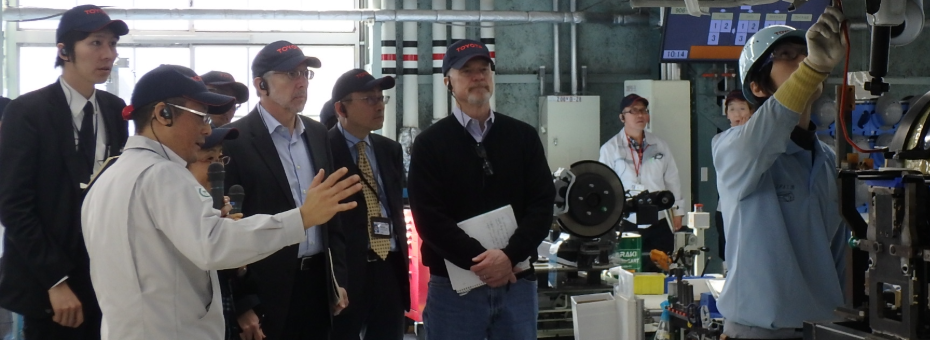
Jeff LIker and Jim Morgan learning at Toyota in Japan.

I could go on as I am sure you could. But what might be more useful is to suggest some principles to guide our experimentation with AI in LPPD. The principles Toyota shared with my co-author Jeff Liker and me over 20 years ago are worth seriously considering again in this totally new context: 

  1. Seamlessly integrate technology into the development system – don’t treat it as a “bolt-on”.  
  2. Customize the technology to fit your needs.  Take the time to truly understand its implications. 
  3. Start with right-sized tech, not king-sized. 
  4. Use it to enhance people’s performance, not to eliminate them. Technology should be in the service of people, not people in the service of technology.  
  5. Implement tech to improve your ability to deliver new value to your customer, not for its own sake. 

Not perfect, and certainly not comprehensive, but not a bad place to start either. 

FacebookTweetLinkedInPrintComment

Designing the Future Using Lean Product and Process Development

Learn how to reduce time to market, improve quality, and drive innovation in a hands-on, coach-led experience that applies Lean Product and Process Development across your value stream.


Written by:

James Morgan, PhD

About James Morgan, PhD

Jim is a senior advisor at Lean Enterprise Institute and a board member at Adrian Steel. He has a unique blend of industry leadership experience and rigorous scholarship, which he draws upon to improve organizational performance at a select group of companies.  Jim’s most recent industry experience was as Chief…

Read more about James Morgan, PhD

Leave a Comment Cancel reply

Your email address will not be published. Required fields are marked *

Related

The Design Brief: How I’ve Aimed to Share the Uncommon Knowledge of Lean Product and Process Development

Product & Process Development

How I’ve Aimed to Share the Uncommon Knowledge of Lean Product and Process Development

Article by Larry Navarre

Innovation as a Core Capability: Sebastian Fixson on Why Leaders Need Lean Product and Process Development 

Product & Process Development

Innovation as a Core Capability: Sebastian Fixson on Why Leaders Need Lean Product and Process Development 

Article by Sebastian Fixson and James Morgan, PhD

Data is Good; Facts that Tell You What’s Actually Happening in Your Business Are Better 

Product & Process Development

Data is Good; Facts that Tell You What’s Actually Happening in Your Business Are Better 

Article by Eric Ethington

Related books

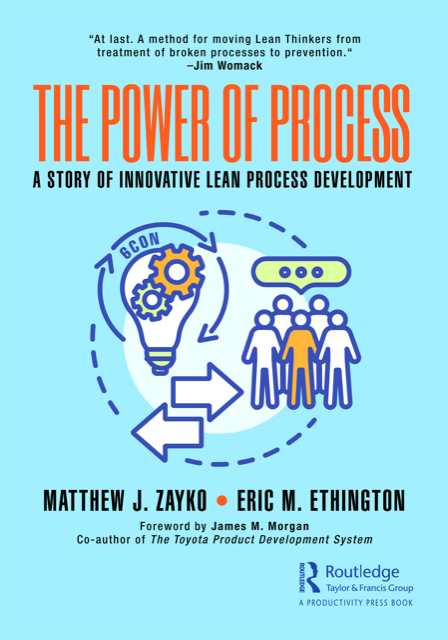
The Power of Process book cover

The Power of Process – A Story of Innovative Lean Process Development

by Eric Ethington and Matt Zayko

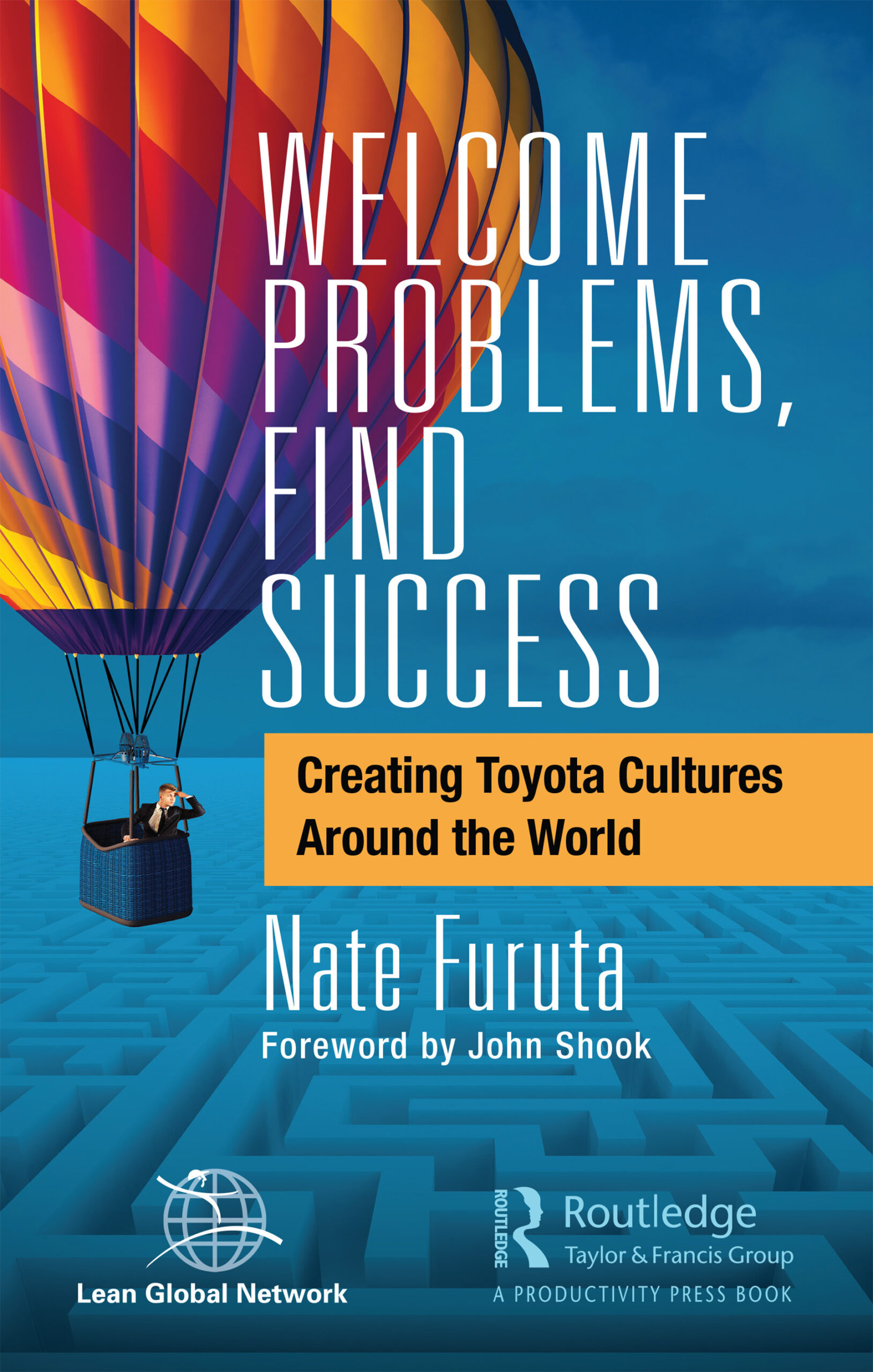
Welcome Problems, Find Success – Creating Toyota Cultures Around the World

Welcome Problems, Find Success – Creating Toyota Cultures Around the World

by Nate Furuta

Related events

September 22, 2025 | Coach-Led Online Course

Designing the Future Using Lean Product and Process Development

Learn more

October 07, 2025 | Rochester, MI

Introduction to Lean Process Development

Learn more

Explore topics

Product and Process Development graphic icon Product & Process Development

Sign up to be notified about new events

Subscribe
  • Privacy Policy
  • Sitemap
  • LinkedIn
  • Twitter
  • YouTube
  • Instagram
  • Facebook

©Copyright 2000-2025 Lean Enterprise Institute, Inc. All rights reserved.
Lean Enterprise Institute, the leaper image, and stick figure are registered trademarks of Lean Enterprise Institute, Inc.

This website uses cookies to improve your experience. We'll assume you're ok with this, but you can opt-out if you wish. Learn More. ACCEPT
Privacy & Cookies Policy

Privacy Overview

This website uses cookies to improve your experience while you navigate through the website. Out of these cookies, the cookies that are categorized as necessary are stored on your browser as they are essential for the working of basic functionalities of the website. We also use third-party cookies that help us analyze and understand how you use this website. These cookies will be stored in your browser only with your consent. You also have the option to opt-out of these cookies. But opting out of some of these cookies may have an effect on your browsing experience.
Necessary
Always Enabled
Necessary cookies are absolutely essential for the website to function properly. This category only includes cookies that ensures basic functionalities and security features of the website. These cookies do not store any personal information.
Non-necessary
Any cookies that may not be particularly necessary for the website to function and is used specifically to collect user personal data via analytics, ads, other embedded contents are termed as non-necessary cookies. It is mandatory to procure user consent prior to running these cookies on your website.
SAVE & ACCEPT